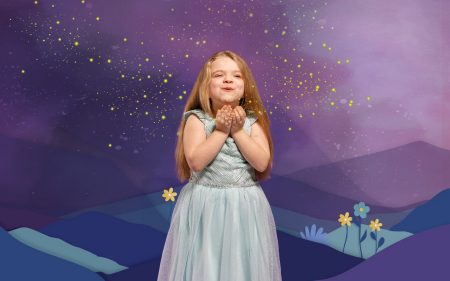
Not even the sky is the limit for Slater
Watching a St. Jude cancer survivor launch into space, Slater and his family glimpse a future once unimaginable — and full of possibility.

July 01, 2026 • 6 min


The boys stand in sandals at the edge of their street, shoulders nearly touching, looking up as the night sky ignites. A luminous plume unfurls. At its peak, a bright point of light climbs higher and higher — a rocket carrying a story they know by heart.
On board is Hayley Arceneaux — a physician assistant at St. Jude Children’s Research Hospital® and a childhood cancer survivor. Now she is soaring into space.
Behind the boys, their dad, Shane, lifts his phone to capture the moment. In the photo, the younger boy, Slater, stands steady, his hair — once lost during chemotherapy — now brushing his shoulders. His older brother, Sawyer, is beside him, as always.
SpaceX’s Inspiration4, the first all-civilian orbital mission, launched Sept. 15, 2021, raising an astronomical $250 million for St. Jude.
For this family, watching from their Florida neighborhood, it is more than a historic launch. It is a promise of what's possible for Slater.

Just a few years earlier, the future didn’t reach this far.
Finding lifesaving care
In 2018, when Slater was 4, he complained one night that his right leg ached. At preschool the next day, he sat out at recess.
That afternoon, his parents took Slater to the emergency room, the start of an arduous journey that would lead to an MRI. The scan revealed a bone lesion, and Slater was referred to oncology.
What the doctor said dropped Shane to his knees. Slater had neuroblastoma, a pediatric cancer that develops in immature nerve cells. Scans showed the disease had spread to his hips, pelvis, abdomen and spine. Shari begged to know where they could find lifesaving care for their child.
The doctor referred Slater to St. Jude, where he qualified for an innovative clinical trial for patients with newly diagnosed, high-risk neuroblastoma that introduced immunotherapy earlier in treatment.
It was the hope the family held onto.
Finding hope

The family arrived at St. Jude after 7 p.m. on April 3, 2018, exhausted from weeks of uncertainty and cross-country travel.
“Seeing that St. Jude statue and walking through those doors,” Shari said, “I felt hope for the first time.” For Shane, the pictures on the walls of kids — many bald from treatment — made it suddenly real.
Though it was late, pediatric oncologist Sara Federico, MD, was there to meet them. First, she addressed what Shari had been quietly carrying: This was not their fault. There were no warning signs they had missed.
With the same certainty, Federico explained how Slater could be treated by combining chemotherapy and immunotherapy, an approach which was showing improvements in outcomes for children with high-risk neuroblastoma but had only been used in later stages of therapy. Slater would be on a clinical trial that aimed to find out if adding immunotherapy (a specific antibody directed against the tumor) to the early rounds of chemotherapy could further improve outcomes by helping the body target and kill cancer cells at an even earlier stage.
At St. Jude, an MBIG scan, a specialized form of imaging, showed that Slater’s cancer had spread throughout his body, including to his bone marrow. Treatment would be tough. But the approach — three phases over roughly 18 months, including a stem cell transplant using Slater’s own cells — was built on previous research that suggested striking results were possible.
“From that point on,” Shane said, “I knew we were in the right place.”

In it together
At St. Jude, the family lived in a two-bedroom apartment in hospital housing. Outside their door, Shari placed chairs and a table. She bought colorful bed sheets for the boys and cozy rugs. All touches of home.
Shane and Shari got to know other parents of patients. Their kids sometimes rode scooters or raced remote-control cars together. Slater often was too weak to play, watching from a wagon with a pillow and blanket.
“That community was a huge part of our recovery,” Shari said. “You’re in it together. You lift each other up.”
Slater spent more than half his time inpatient. Sawyer perched in a chair beside Slater’s bed, instinctively knowing when to grab the emesis bag and rub his brother’s back. Video games were their favorite escape.
There was art therapy. Music therapy. Slater remembers fragments: “sleepy medicine,” choosing toy cars from the “Happy Cart,” a roving gift and activities cart, moments of fear — and feeling cared for. “What made me feel brave,” he said, “is how they took really good care of our entire family.”
Six months into treatment, advanced imaging and tests showed no remaining traces of active tumor, and Slater received a stem cell transplant, using his own cells, and proton beam radiotherapy in hopes of preventing his cancer from returning.

His care followed the plan Dr. Federico had outlined, and in May 2019, Slater completed treatment. After 424 days, he and his family got to go home.
Frozen in time
After more than a year away, their home was frozen in time. Slater’s preschool backpack sat in the hallway. Sneakers he’d left by the front door didn’t fit anymore.
The house held the life they had paused — and everything they had missed. “I grieved the life before,” Shari said. But they were grateful for the life after. Coming home with their child was a gift. Not every family does.
Slater was still healing, underweight and on a feeding tube. Slowly, life resumed. They went to the beach. The zoo. Amusement parks. Ordinary outings that now felt extraordinary.
“We always did all of those things before. I couldn’t fathom an expiration date on them,” Shari said. “St. Jude made me realize life isn’t guaranteed.”
Slater was born the day before Sawyer’s second birthday. To Sawyer, his brother was a present. They’re together in almost every family picture. They still do nearly everything together — video games, basketball, fishing and miniature golfing.

Slater wears a necklace Sawyer gave him: two penguins, one small, one big. “It reminds me of me and my brother,” Slater said. “And how we’ll always be brothers.”
Life after cancer
Now in middle school, Slater attended his first school dance, placed second in the science fair and discovered a growing love of digital media and animation.
Sawyer plays hockey, and on Tuesdays, Slater takes ice skating lessons, growing steadier and faster each week. Ordinary markers of childhood — and extraordinary proof of how far Slater has come.
Slater’s feeding tube came out after 800 days. “Prior to that, he was such a picky eater,” Shari said. Now, he’s a foodie, willing to try almost anything. He took cooking classes and wants to be a chef.
His best dish is his “famous burgers,” Slater said, making quote marks in the air with his fingers. He seasons the meat from high above with a practiced flair, so the spices don’t land in just one spot. His secret, he said, is seasoning the sides of the burgers too.

“If it wasn’t for me going to St. Jude, I wouldn’t have the life I have today,” Slater said. “I wouldn’t have made all the friends I’ve made or done the things I’ve done.”
Even now, his parents worry. Lingering side effects and routine checkups at St. Jude pull them back to whatifs. “You see the fragility of life. People are precious. Time is limited,” Shari said. “We understand the value of every day.”
If Slater gets a headache or stomachache, Shane suppresses his panic. At the same time, the experience reshaped him. “I now believe you can overcome anything,” Shane said.
No limits
That night, as Slater stood beneath the open sky, he watched someone who had been through what he’d been through — another St. Jude cancer survivor — rise above it.
Arceneaux was 10 when she was treated at St. Jude for bone cancer in her left leg. At 29, she became the youngest American to orbit Earth, the first pediatric cancer survivor in space and the first astronaut with a prosthetic.
For Slater’s family, her journey was proof. “Even the sky is no longer the limit,” Shari said.
Nearly seven years later, Slater still shows no evidence of cancer. “With St. Jude, these kids really do overcome seemingly insurmountable obstacles,” Shane said.
As the rocket disappeared into the darkness, the sky did more than open that night. It expanded.
On clear nights, that looks like a boy standing steady beneath an endless sky — seeing not just how far others have gone, but how far he might go.