St. Jude Family of Websites
Explore our cutting edge research, world-class patient care, career opportunities and more.
St. Jude Children's Research Hospital Home
- Fundraising
St. Jude Family of Websites
Explore our cutting edge research, world-class patient care, career opportunities and more.
St. Jude Children's Research Hospital Home
- Fundraising
Computing Systems
The High-Performance Compute (HPC) environment provides resources comprised of 5.3 PFLOPs of compute power and over 150 PB research storage capacity. Our on-site Data Center is the major computing hub on campus. It houses an ML/AI cluster as well as the HPC while the cloud allows us to extend computing capability on the fly.
HPC Research Cluster
The High-Performance Computing Research cluster consists of more than 300 general nodes with 25,000 cores. In addition to the general nodes, there are approximately 60 GPU nodes with over 400 GPUs installed and housed in the St. Jude Data Center. A secure compliant environment for computing is available, providing a location for sensitive and regulated information.
PCAI AI/ML Inference Cluster
The Artificial Intelligence and Machine Learning (AI/ML) cluster is built for AI/ML inference use cases serving AI/ML models including, but not limited to, deep-learning models, foundational modals, large language models (LLMs) and others.
The cluster is an ideal platform to serve foundational models either publicly available or internally trained on non-public data. It consists of an MLOps platform spanning 10 DGX A100 worker nodes with plans to expand to more nodes and Cloud compute capabilities. The ML/AI cluster is engineered to facilitate modern AI workloads that require large GPU memory, multi-GPU model training, or have large, shared datasets. This cluster is ideal for your Deep Learning infrastructure needs.
| Node type | Node | CPU cores per node | GPUs per node | GPU type | GPU memory per node | RAM per node |
|---|---|---|---|---|---|---|
| HPE ProLiant DL380a | 2 | 128 | 4 | NVIDIA-L40S | 192 GB | 512 GB |
Slurm AI/ML Training Cluster
This model training cluster is comprised of many of the latest and best GPU nodes available, with a network optimized for training large, multi-node, multi-gpu AI models.
In addition to the following resources, the compute network is composed of infiniband switches enabling GPU Direct RDMA, and a separate infiniband storage network attached to a DDN AICD2 storage device enabling GPU Direct Storage (GDS).
| Node type | Nodes | CPU cores per node | GPUs per node | GPU type | GPU memory per node | RAM per node |
|---|---|---|---|---|---|---|
| Cray XD670 | 14 | 112 | 8 | Nvidia H100 SXM | 80 GB | 1024 GB |

Virtual Reality and Visualization (VR/Vis)
VR/Vis
St. Jude's Virtual Reality (VR) Lab and a Visualization (Vis) Lab resides in the new Inspiration4 Advanced Research Center building. It is designed to support St. Jude researchers in using state-of-the-art visualization technologies, such as VR and Interactive Display Walls (IDW). Advanced visualization can be used for modeling and rendering high-dimensional research data and biological systems for insights and knowledge discovery. The technology includes VR-ready graphics workstations, visualization software and high-speed network connectivity.
Vis Lab
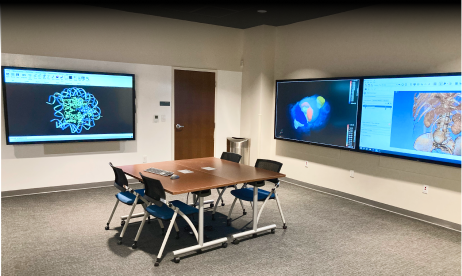
The Vis Lab contains a massive pixel environment with three 86" interactive, 4K-resolution, multi-touch display walls (DWs). Each DW forms part of a shared desktop space and displays video feeds from a dedicated visualization workstation or external systems connected via e.g. Remote Desktop protocols. Individual video feeds from different applications can be shown on their own DW, or spread across all DWs. Modular tables allow easy reconfiguration of the space.
Computer Room
The Computer Room contains two visualization workstations, each connected to dual 42" 4K displays. The workstations provide access to software for visualization and analysis of 3D data sets from microscopy and molecular sciences, for example:
*Including Imaris File Converter and Imaris Stitcher
VR Lab
The VR Lab is a room-scale immersive virtual reality environment featuring wireless Vive XR Elite head-mounted displays (HMDs) with "inside-out" motion sensing and 3D controllers that provide haptic feedback. The HMDs are connected to two dedicated VR workstations via a wall-mounted 55" touchscreen that also mirrors the VR output for non-VR participants.
The VR workstations provide VR output from compatible pre-installed software, such as: