St. Jude Family of Websites
Explore our cutting edge research, world-class patient care, career opportunities and more.
St. Jude Children's Research Hospital Home
- Fundraising
St. Jude Family of Websites
Explore our cutting edge research, world-class patient care, career opportunities and more.
St. Jude Children's Research Hospital Home
- Fundraising
When James R. Downing, MD, took on the role of President and CEO at St. Jude, he assumed the leadership of an institution with a singular dedication to patient care and a formidable scientific foundation.
What he helped build over the next 12 years was something more expansive: a way of thinking about discovery, responsibility, and scale that reshaped how pediatric diseases are studied, treated, and shared with the world.
Downing’s leadership has been marked by a steady conviction that progress does not happen by waiting for the right circumstances. If the path to curing childhood cancer did not yet exist, it was the obligation of St. Jude to create it. As Downing prepares to transition from CEO and return to the faculty, his legacy is not defined by any one initiative. It is visible in the systems he built, the values and culture he reinforced, and the future he positioned St. Jude to lead.
“What makes St. Jude such a remarkable place comes in the legacy of its founders. Dr. Downing has been absolutely true to that legacy in everything he has done,” said Terrence Geiger, MD, PhD, Academic and Biomedical Operations senior vice president and deputy director.
Extending the mission beyond borders
Downing’s vision for St. Jude has never been limited by geography. Recognizing that the greatest determinant of childhood cancer survival globally is location, he led the creation of St. Jude Global to extend the hospital’s mission worldwide.
Under the banner of St. Jude Global, St. Jude has cultivated strategic partnerships, including a landmark collaboration with World Health Organization. Through these efforts, St. Jude launched the Global Initiative for Childhood Cancer, and programs such as the Global Platform for Access to Childhood Cancer Medicines, which have created tangible improvements in care.
Carlos Rodriguez-Galindo, MD, St. Jude Global director, framed the effort as an extension of the hospital’s founding promise. “That dream, that no child should die in the dawn of life, is a global mandate,” he said. Bridging the gap between what is scientifically possible and what is globally available, he noted, is central to Downing’s legacy.
Downing plans to take on a faculty role in the Department of Global Pediatric Medicine, keeping him closely connected to the work he helped launch.
Building a genomic blueprint for pediatric cancer
Before assuming the leadership of St. Jude, Downing was a pediatric cancer research pioneer. When the fields of genomics and genomic medicine were still emerging, he spearheaded the St. Jude Children’s Research Hospital–Washington University Pediatric Cancer Genome Project (PCGP). Announced in 2010, this was among the largest genome sequencing efforts at the time and the most ambitious effort to understand the effect of genetics on childhood malignancies.
The PCGP comprehensively sequenced tumor and normal genomes from pediatric cancers at an unprecedented scale. Supported by $65 million in funding to build the necessary infrastructure, whole genomes from more than 800 patients were sequenced. The project demonstrated what was possible when vision, collaboration, and investment aligned, and became a resource of information that sparked groundbreaking discoveries in pediatric cancer biology. The impact was immediate and enduring. The PCGP revealed the unique molecular landscapes of pediatric tumors, reshaping diagnostic strategies and laying the groundwork for precision medicine approaches now embedded in pediatric oncology. Its findings informed clinical trial design, guided therapy selection, and contributed to the creation of programs such as the St. Jude Cancer Predisposition Clinic.
More broadly, the PCGP established a blueprint for how St. Jude would operate at scale. “By recognizing the power of discovery science and the amplifying power of collaboration, Dr. Downing markedly accelerated the impact of St. Jude on catastrophic diseases of childhood and elevated recognition of St. Jude as a world-class research institution,” said Charles W.M. Roberts, MD, PhD, St. Jude Comprehensive Cancer Center director. “This positions St. Jude for a transformative future.”

From data generation to data science powerhouse
The PCGP demonstrated that openly shared knowledge could impact both science and institutional structure. Downing’s belief in removing barriers to information found one of its most meaningful expressions in the St. Jude Cloud. Designed to increase access to pediatric cancer genomic data, the platform positioned St. Jude as a global catalyst for discovery.
“Dr. Downing’s legacy is that St. Jude no longer simply participates in global science; the institution actually helps shape global science,” said M. Madan Babu, PhD, Senior Vice President for Data Science. By championing openness, Downing mobilized institutional data as a global resource, accelerating collaboration and discovery across continents.
That vision continues to evolve through the Data Science Initiative, integrating artificial intelligence, computation, and biology to push pediatric research into its next frontier.
Fundamental science as the engine of discovery
Throughout his leadership, Downing has remained a steadfast champion of fundamental science, viewing curiosity-driven research as the foundation for every future cure. He reinforced the idea that understanding disease biology is not separate from patient care, but essential to it.
“Over the course of Dr. Downing’s leadership as CEO, we have gone from being a good fundamental research institute to a premier fundamental research institute,” said J. Paul Taylor, MD, PhD, Scientific Director. He emphasized that the dividends of that investment will unfold over decades, shaping textbooks, informing therapeutic targets, and enabling treatments that would not otherwise be possible.
Taylor described Downing as a leader who “gave permission and license for people to think outside the box,” creating space for innovation that challenged conventional boundaries and seeded some of the institution’s most impactful programs.
Growth you can see, built for what comes next
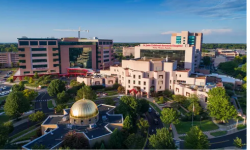
The expansion of St. Jude under Downing’s leadership is visible not only in programs and partnerships but in the campus itself. A $12.9 billion strategic expansion is underway to accelerate research and clinical care, including two 15-story clinical and clinical-research buildings and the 16-story Advanced Research Center II. These projects build on earlier developments, such as the Inspiration4 Advanced Research Center, the Domino’s Village patient housing and the Family Commons patient housing and Family Commons — spaces designed to support the lived experience of children with cancer and their families.
“Every time we have a new building on campus, I think it has the same characteristics as St. Jude: optimism, hope, and excitement for the future,” said Ellis Neufeld, MD, PhD, Clinical Director and Physician-In-Chief.
The physical spaces at St. Jude are a manifestation of the expansion of the institution’s discovery and care. However, Downing’s attention to the well-being of patients, families, and staff goes beyond building the campus. Through his tenure, he has overseen programs such as Paws at Play, the facility dog program that provides animal-assisted therapy to reduce stress for patients, families, and staff, while also living, codifying, and celebrating the values and culture that make St. Jude unique.
A legacy that points forward
The St. Jude that Downing shaped is defined as much by its potential as by its achievements. The systems he championed ensure that discovery moves faster, collaboration reaches farther, and care continues to improve for children everywhere. His legacy is embedded in how St. Jude thinks, builds, and shares. The chapters he wrote contain some of the most transformative moments in the institution’s history. As new leadership prepares to carry St. Jude into its next era, the institution’s future will be built on a foundation shaped by Downing’s legacy.