St. Jude Family of Websites
Explore our cutting edge research, world-class patient care, career opportunities and more.
St. Jude Children's Research Hospital Home
- Fundraising
St. Jude Family of Websites
Explore our cutting edge research, world-class patient care, career opportunities and more.
St. Jude Children's Research Hospital Home
- Fundraising
5 Questions for Yuliana Díaz Tirado
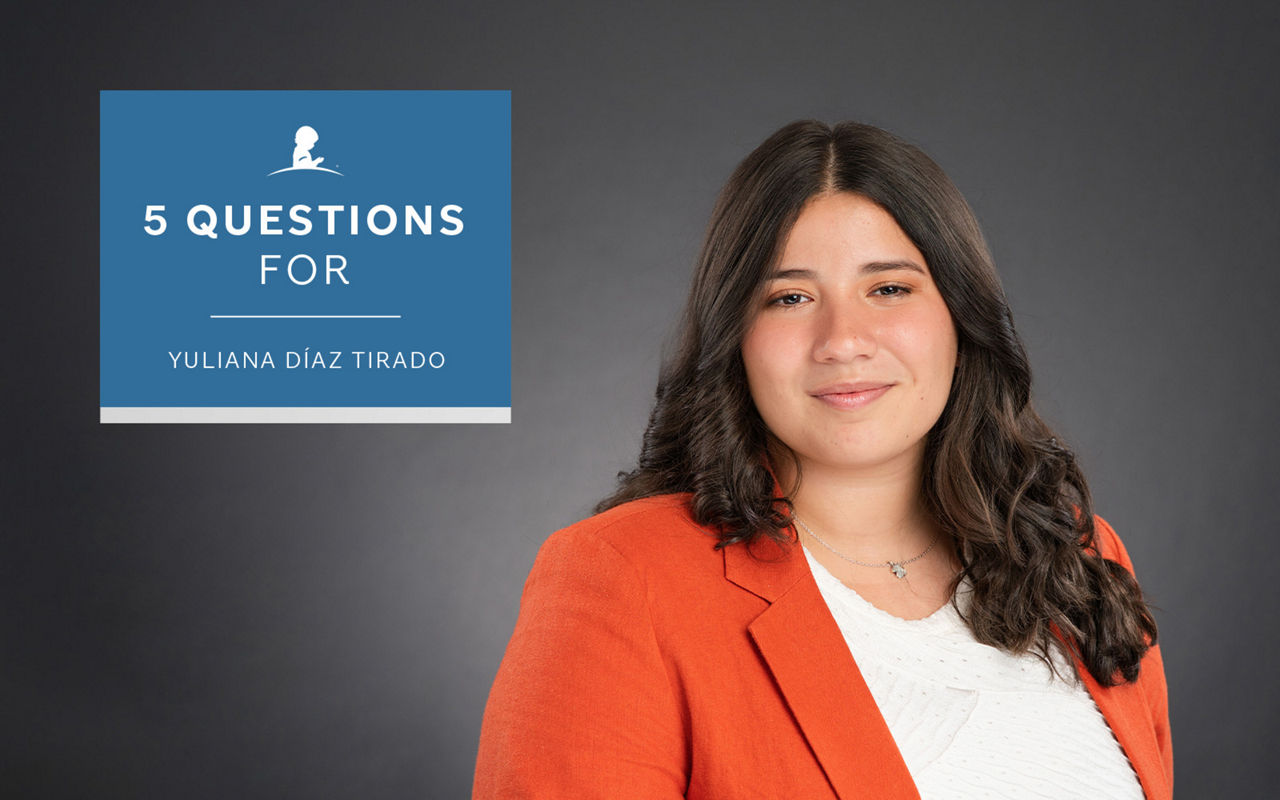
At the St. Jude Graduate School of Biomedical Sciences, Yuliana Díaz Tirado found purpose and support.
This question-and-answer series explores the motivations, inspirations and accomplishments of current and former students at the St. Jude Children’s Research Hospital Graduate School of Biomedical Sciences.
Yuliana Díaz Tirado is a PhD student at the St. Jude Graduate School of Biomedical Sciences. She is doing her doctoral research in the Department of Oncology, in the lab of Alejandro Gutiérrez, MD. Before joining the program, she participated in the National Institutes of Health Postbaccalaureate Research Education Program (PREP) at UC Berkeley, working in the lab of Hernan Garcia, PhD.
1. What motivated you to pursue a career in science?
Growing up, I was always very curious. I wanted to be an anthropologist, and then I wanted to be a judge. I considered being a teacher, but I also liked science. The one thing that was constant through all that was caring for children.
When Hurricane Maria hit Puerto Rico, where I am from, in 2017, I was in my senior year of high school and had to decide on a major. Nearly 3,000 people died because of the devastation that happened. People didn’t have electricity, access to water or essential health care.
What struck me was that I wanted to have the tools to help people. I know there are many different careers where you can do that, but in that moment, medicine spoke to me. It blended two constants in my life: science and helping people.

Díaz Tirado speaks at a Graduate School event.
2. What questions have you explored through your research?
During my undergrad, my chemistry professor, Brad Weiner, PhD, invited me to do research that was more physics related — ways to synthesize graphene with high electrical conductivity to absorb CO2 in the environment and clean water. It was funded by the Puerto Rico NASA Space Grant.
As I got further into my undergrad degree, the teaching assistant for a biotechnology course, Carlos Morales, in the lab of Esther Peterson-Peguero, PhD, invited me to collaborate on his project. We worked on inflammatory breast cancer, looking for novel fusion mutations. That was more computational; I mainly did wet-lab validation. I stayed an extra semester, with no credit, to spend more time in that lab.
At UC Berkeley, we were studying development in Drosophila (fruit flies), looking at the early genes that get activated to dictate the pattern segments in the fly during development. That was in the Garcia lab with Julia Falo-Sanjuan, PhD.
At St. Jude, I’m focusing on an enzyme that drives some forms of liposarcoma. This cancer has a low mortality rate, but it comes back aggressively, and it has a high recurrence rate. It’s also very chemotherapy-resistant. We’re trying to find new targets that could help identify vulnerabilities in that cancer.
3. What factors went into your decision to pursue a PhD at St. Jude Children’s Research Hospital Graduate School of Biomedical Sciences?
I went to a conference where I got to have dinner with the dean of the grad school [Steven Varga, PhD], and he suggested I apply. I’ve always been very passionate about helping kids, so coming here and knowing all the work that I do would have an impact on children’s lives, and learning about the mission, and discovering the diversity of the research they do — it’s predominantly cancer, but we study microbes, infections, diseases, neuropathologies and very basic research too — all that played a role.

Díaz Tirado receiving her white lab coat upon entrance to the Graduate School.
I also knew I would have a lot of opportunities in the lab and could volunteer to support the patients. And as part of our first-year classes, we had a rotation where we shadowed physicians in the clinic, which I thought was very interesting. Not a lot of programs offer that. It is a very competitive program in terms of everything it offers.
4. In what ways did your mentors help shape your career in research?
They’re the main reason I chose this career. They inspired me and showed me the path. They recognized my abilities, intelligence and skills, and challenged me in ways I didn’t think I could be challenged. When I didn’t think I was good enough, or was afraid I would fail, or worried I did everything wrong, they had the patience and the wisdom to help me see that some things are going to fail, and they’re not going to be your fault because a negative result is still a result. You’ve got to find 1,000 ways of not doing it the right way until you find the right way. Every piece of knowledge you acquire is progress.
Without those mentors, I wouldn’t be here. I would have probably pursued a more traditional route. In Puerto Rico, if you do science, you do an MD, or maybe work in biotechnology, like in quality control. A lot of medical devices are produced there, so maybe that would have been my route.
My mentors said, “No, jump in.” I moved to California by myself, completely alone. I wasn’t sure if I should do it, but they said, “Yes, you can.” Those experiences helped me decide what I wanted to do later.
5. Speaking of: What do you intend to achieve during your PhD program and beyond?
I want to be a mentor to other people, so I can give back what I’ve been given. I might change my mind later, but that’s what I think about now: giving Puerto Ricans equal, high-quality opportunities to do science at home. I want to go back with the knowledge, the connections and, hopefully, the funding to open my own lab and then mentor other students so they can go on and keep impacting everyone.
About the author


