St. Jude Family of Websites
Explore our cutting edge research, world-class patient care, career opportunities and more.
St. Jude Children's Research Hospital Home
- Fundraising
St. Jude Family of Websites
Explore our cutting edge research, world-class patient care, career opportunities and more.
St. Jude Children's Research Hospital Home
- Fundraising
Putting the patient experience at the center of neurology treatment
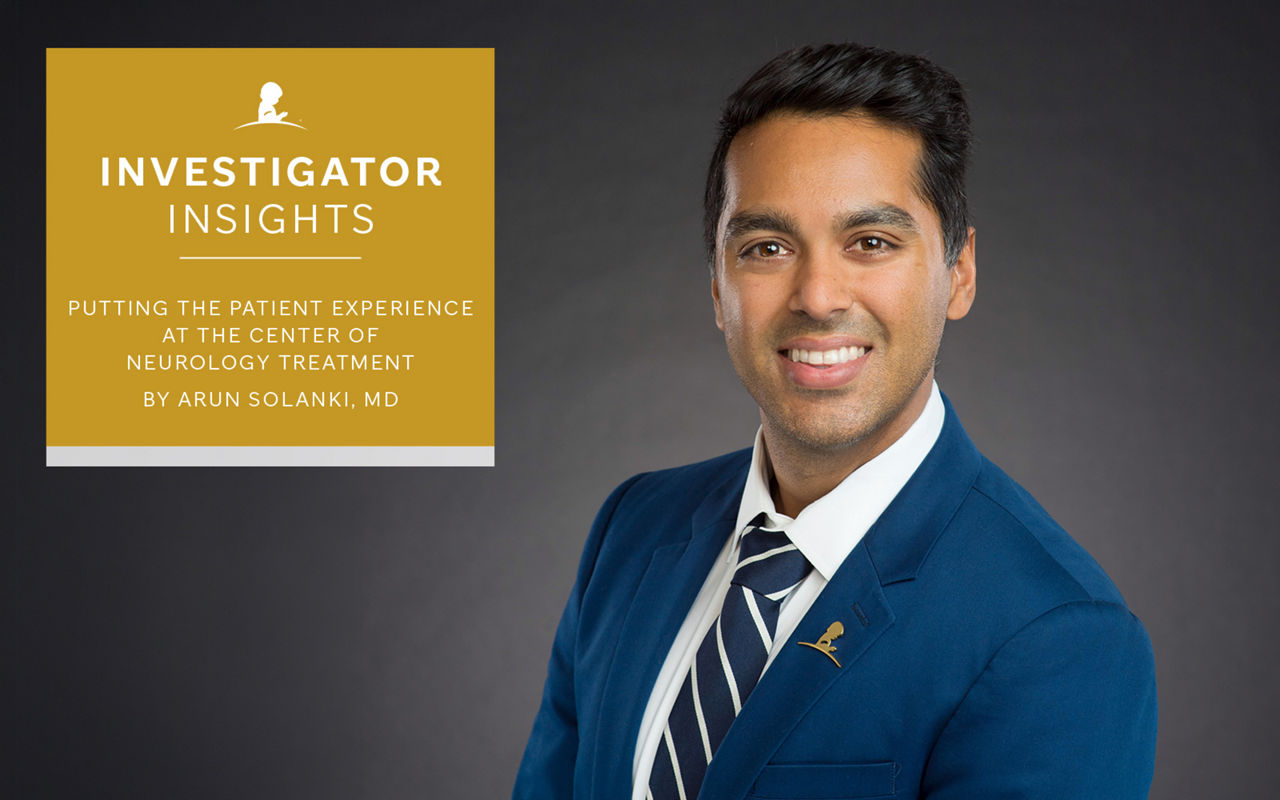
After starting his own pediatric neurology practice, Arun Solanki, MD, received a call from Richard Finkel, MD, director of the Center for Experimental Neurotherapeutics (CENT), that changed the trajectory of his career. Today, he helps shape the design and implementation of therapies for rare neurologic diseases at St. Jude.
I’ve always enjoyed connecting with people and learning their stories. My mother was a neonatal intensive care unit (NICU) nurse, and I had the opportunity to volunteer at the hospital where she worked. What stood out to me was how much time neurologists spent talking with patients. It wasn’t just medical histories — they were talking about everything in patients’ lives that had led them up to that point, taking time to really understand those experiences. That appealed to me, so I decided that neurology, specifically pediatric neurology, offered the scientific depth and the patient interaction I wanted in my career.
After medical school and residency, I opened my own pediatric neurology clinic here in Memphis. It was a great experience — I had time to really get to know patients and follow their treatment over time. But I started noticing major gaps in care, especially in the Memphis region. There just weren’t enough child neurologists, forcing patients to travel long distances just to get basic care. Pediatricians located two hours away would say, “This child just had a seizure. I need an electroencephalogram (EEG) test now. I can’t wait six months for a neurology appointment.”
That led me to work with Baptist Memorial Hospital on expanding access through telemedicine and tele-neurology. We worked with community sites to perform tests locally and interpret the results remotely, so patients didn’t have to travel as far, allowing for quicker turnaround.
Around this time was when Richard Finkel, MD, Center for Experimental Neurotherapeutics (CENT) director and Department of Genomic and Translational Neuroscience member, reached out to me. I had attended many of Dr. Finkel’s due to his neuromuscular expertise, and I was very aware of the research focus at St. Jude. I made it clear I wasn’t a researcher and had never developed a clinical trial. He told me that he didn’t need me to be a researcher. He needed a clinician.
Bridging the gap between research and clinic
Neurologists like me traditionally work in our own lane, often waiting years for scientific breakthroughs to become available in clinical practice. What Dr. Finkel was pitching was CENT, a program within the Pediatric Translational Neuroscience Initiative (PTNI) where researchers and clinicians work hand in hand. He didn’t need me to develop the drug or create the protocol. He needed me to evaluate the patients and see what I could learn from their exams so that when we develop a drug or therapy, we’re able to determine whether it’s actually helping.
At first, I had some imposter syndrome, wondering what I could contribute to such a vision. There are researchers here who have dedicated their lives to studying neuromuscular disorders such as ataxia telangiectasia (AT), but when I described what these patients experience, what their symptoms are, how they move through the world, the researchers gained a new perspective.
I invited them to see these patients in clinic and remember one scientist who had been researching these conditions for decades saying, “That was incredible. Thank you for letting me see that patient, because I had no idea.”
That was the first moment I realized the value I brought to this team. The researchers define conceptually what should be measured but implementing those ideas in the clinic — that’s me. I tell them what’s working and what isn’t. We’re constantly influencing each other and refining what we want to measure when therapies are introduced.
An emphasis on family-centered outcomes
Aside from my responsibilities with CENT, I also assist with neurology more broadly within the hospital. From inpatient work, I already had relationships with Rehabilitation Services, such as speech and language therapy, Child Life and other support services. Because of that network, I was able to bring those resources into CENT.
We now have speech and language therapy involved with many of our patients, including speech therapy outcomes, which we never would have considered before. A lot of our patients have cognitive or behavioral issues that make procedures difficult too, even blood draws. Child Life used not to be involved in many visits, but now they’re fully integrated into our program.
One of the biggest collaborations has been with the Cancer Predisposition Program. They were already seeing some AT patients due to their higher cancer risk, but we also started seeing these patients in CENT because there are possible intervention studies for their condition. So now we’re assessing those patients and looking at more meaningful outcomes, really going beyond standard neurology care.
Throughout this process, we don’t just emphasize patient-centered outcomes; we also want family-centered outcomes. When we first meet the families, we sit with them for hours. We’re evaluating not just the kids, but how things are going with the parents, too.
Our natural history work isn’t just about looking at how patients walk or whether they can walk 50 meters faster than they could before. That’s part of it, but we’re also asking: How’s your endurance? How’s your quality of life? How’s school going? Are you doing more activities? How are your interactions? How’s your mental health?
Friedreich’s ataxia, for example, is often diagnosed around ages 10 to 12. That’s already a hugely transformative time in someone’s life, and then suddenly they receive a diagnosis of a life-altering neurological condition. That has a major mental health impact.
So, we ask: Do we need mental health outcomes? Neuropsychological outcomes? Should we assess executive functioning, processing ability, memory, the ability to work through complex tasks? Those are things a typical neurology visit often doesn’t assess. This deep evaluation doesn’t just look at fine motor skills, gross motor skills or speech. It asks how someone is functioning day to day.
Building a broader future for patient care
Our goal at CENT is to build comprehensive natural histories and phenotypes, not just for childhood, but into young adulthood and adulthood. That allows us to understand whether an intervention is helping.
Once those frameworks exist, it becomes much easier to advocate for necessary research. We can say: We have strong natural history data, we understand what these patients experience clinically, we know what meaningful outcomes are, and now this disease is ready for intervention.
We also share these findings with patient family groups who can then advocate for research by pointing to our established frameworks and measurable outcomes. That makes industry much more willing to invest.
Right now, we are focusing on small populations and rare disorders, but this lays out the groundwork for future rare disease studies as well; the overall framework is flexible. We can pivot to a new genetic disorder or disease category and apply everything we’ve already learned. This was a major reason I decided to pursue a master’s in Clinical Investigations at the St. Jude Graduate School of Biomedical Sciences. I want to take that next step myself, designing protocols and studies.
I never expected to contribute to research the way I do now. I always thought of research as bench work, sitting behind a desk or in a lab looking at outcomes. But this is a completely different type of research. It’s sitting with patients and trying to understand what’s happening and how to make a patient’s life better. It’s an area I was never exposed to before, but I feel excited and so fortunate to have that opportunity now.
About the author


